
When Learning Science Meets Educational Technology
Advancing evidence-based edtech for practice, policy, and system-wide impact

At the International Centre for EdTech Impact, our mission is rooted in a simple but urgent reality: Educational systems worldwide are facing mounting pressure from constrained budgets, workforce shortages, widening inequalities, and overlapping social, economic, and humanitarian crises. At the same time, the learning sciences (or Science of Learning) offer decades of solid, cumulative research that provides concrete, practical guidance on how instruction, learning processes, and education policy can be strengthened. Yet these well-established insights too often fail to reach the technologies and actors that most directly shape everyday educational practice.
Our work exists to close this gap. We bring learning scientists together with developers, curriculum providers, and edtech producers to ensure that the science of learning is not only understood, but actively embedded into design, policy, and practice.
One of the strongest signals from our work this year is that progress accelerates when researchers, practitioners, policymakers, and technology developers actively collaborate on shared solutions. Learning does not happen in isolation, and neither should the work of improving it. Perspectives from neuroscience, pedagogy, digital learning, assessment, and learner wellbeing all contribute to a more complete picture of how learning unfolds across different contexts. When these perspectives are combined with practical and policy insights, evidence becomes more usable and ultimately more impactful.
We have heard it many times before but it is worth repeating that learning is shaped by culture and context. And that hence, technology alone (or national digitisation programmes) cannot improve learning on their own. Conversely, technology based on thoughtful design, community-led implementation and rigorous evaluations can make a significant impact on learning.
This matters deeply in a global context where resources are limited and expectations are high. Governments and education systems cannot afford to invest in tools or programs that fail to deliver meaningful outcomes. Stronger collaboration between the private sector and learning science experts is therefore not optional. Design informed by learning sciences and evidence of what works reduces risk for both schools and investors. It ensures that innovation serves learners.
Looking ahead, there is a growing momentum around deepening our focus on the science of learning and digital education, including AI, hybrid learning models, and learning analytics. We are exploring new ways to support this work, including targeted funding that enables practical experimentation and testing of new innovations, replication and multi-country evaluation studies of parallel digital learning approaches and new measurement tools for international benchmarking of educational impact.
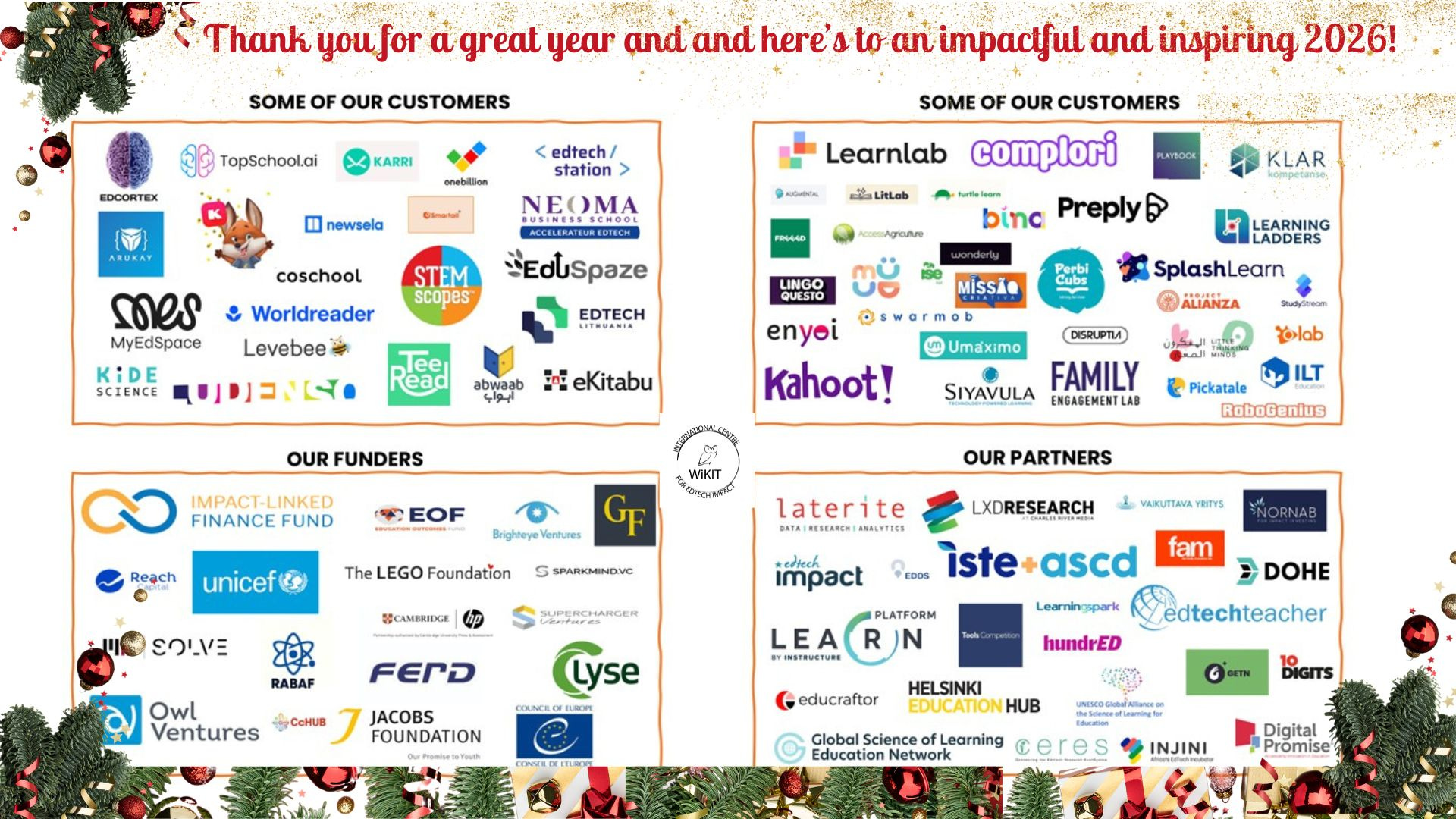
As we close another successful year, we are deeply grateful for the partnerships, collaborations, and shared commitment that have shaped our work. Together with our global community of researchers, developers, educators, and policymakers, we have continued to move evidence closer to practice. We wish all our partners and colleagues a restful holiday season, and a very Merry Christmas. We look forward to continuing this important work together in the year ahead.
Strong articulation of the gap between research and practice in edtech. The insight about combining neuroscience, pedagogy, and digital learning perspectives is spot on, most edtech fails precisely becuase it optimizes for engagement metrics rather than actual learning outcomes. I spent time working with adaptive learning platforms and saw this firsthand, the algorythms prioritized time-on-task over knowledge retention. The call for cost-effectiveness analysis is critical too since many schools are basicaly flying blind on ROI for digital tools.