
Reducing Learning Poverty in the MENA Region with Rama Kayyali of Little Thinking Minds

The Global EdTech Leaders series invites leading experts, practitioners, and collaborators in EdTech to share their insights and vision for the future of educational innovations. Through this series, we hope to promote greater sharing of ideas and knowledge and facilitate important conversations within the EdTech community.
For this article, I connected with Rama Kayyali, CEO and co-founder of Little Thinking Minds, an EdTech company dedicated to closing literacy gaps and reducing learning poverty for the 100 million K-12 Arabic-speaking students across the Middle East and North Africa region and 100 million Arabic speakers beyond.
As an award-winning entrepreneur, Rama is driven to advance language education with evidence-based digital platforms rooted in and informed by diverse cultures. In this interview, she shares the origin story of Little Thinking Minds, its data-driven work in reducing learning poverty in the MENA region, and the role of global partnerships in achieving large-scale impact. Thank you to Rama for generously sharing her time and expertise for this interview.
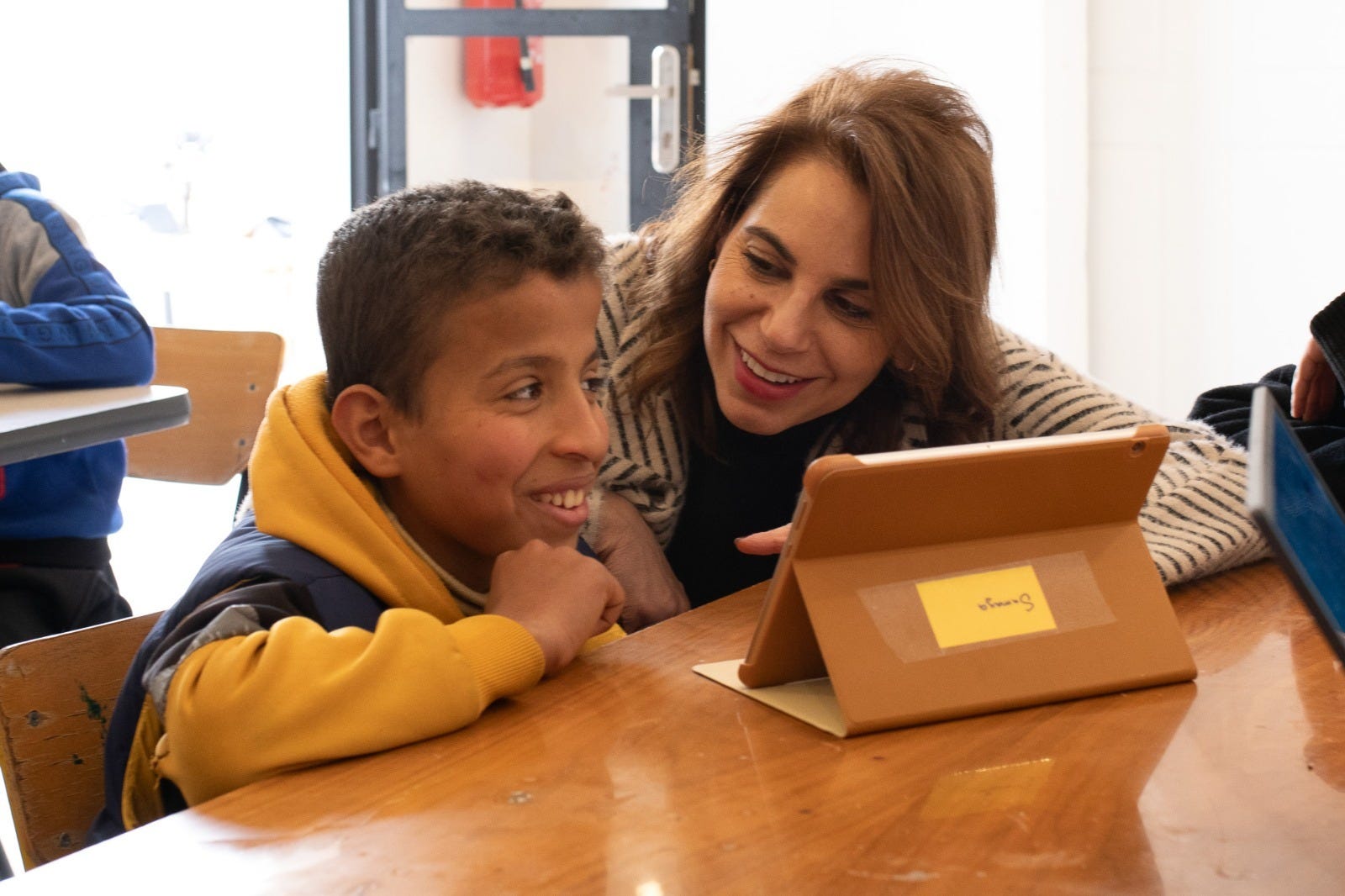
Rama Kayyali (right) engages with a student using Little Thinking Minds’ platform.
For over 16 years, you have led Little Thinking Minds to reach 450,000+ students and improve K–12 Arabic literacy and learning outcomes. Could you share a bit about how you went into EdTech and the vision behind Little Thinking Minds?
When we started Little Thinking Minds over 15 years ago, our vision was simple but urgent: to improve Arabic language literacy for young children. My co-founder Lamia and I, both mothers at the time, were frustrated by the lack of engaging Arabic resources for our own children. We began with DVDs, moved into B2C apps, and eventually pivoted to building full digital platforms for schools. That evolution came from one clear reality: learning poverty in our region is staggering, with nearly 60% of students reading below grade level. Our mission today is to tackle that challenge head-on—using technology to make Arabic literacy engaging, measurable, and scalable.
With our work, we are also driven to nurture a generation of confident, curious, and capable young Arabs. Technology is our enabler: the learning journey is gamified, reward-based, personalized, and adaptive to each child. But equally important is the content itself, it highlights the SDGs, gender equality, and global themes that prepare students to think beyond borders. For teachers, we empower them with access to a rich library of resources, available both online and offline, so they can bring learning to life in any classroom.
Little Thinking Minds is driven by evidence, including measuring literacy gains and engagement data. Can you speak to how evidence helps the organization achieve large-scale impact?
At Little Thinking Minds, we strive to be data-driven because in education, data speaks louder than words. We measure time spent, engagement, and, most importantly, learning outcomes. That includes reading comprehension, oral language fluency, vocabulary acquisition, syllable identification, and more. By understanding exactly where students are struggling and where they’re making progress, we can build better products that directly tackle those challenges. Tracking engagement data and literacy gains doesn’t just prove our impact, it helps us refine and continuously improve. Evidence tells us what works, what needs adjusting, and how to scale solutions that truly move the needle. It also keeps us accountable in a sector where impact is often promised but rarely measured.
Working with private and public schools, Little Thinking Minds serves students in 10 Arab countries. Can you talk a bit about the element of global partnership-building in your work?
We work with private and public schools in 10 Arab countries, including refugee and under-resourced communities. But impact at scale only happens through partnerships with ministries of education, global funders, NGOs, and other EdTech innovators. Every market is different, and collaboration helps us adapt content, align with curricula, and ensure accessibility. Global partnerships also keep us connected to international best practices, while allowing us to bring an authentic Arab perspective to the global education table.
Can you share more about the organization’s collaboration with the International Center of EdTech Impact, such as the projects that you’ve collaborated on?
Our collaboration with the International Center of EdTech Impact helped us move beyond tracking simple usage into actually measuring literacy gains, things like phonological awareness, fluency, vocabulary, and comprehension. Together we built a framework and R script that link student and teacher engagement to real learning outcomes. This gives us robust evidence to show impact at scale and align our work with global education goals.
What are some challenges or opportunities that you see in the field of EdTech?
One of the biggest challenges in EdTech today is the sheer noise in the space; there are so many platforms, but very few can actually prove impact. Teachers, already overwhelmed and overworked, are being asked to juggle multiple tools, which can lead to fatigue rather than empowerment. On the government side, projects often move slowly, with decision-making and procurement cycles stretching out for months if not years. And in many parts of the world, especially in our region, issues like poor connectivity and weak infrastructure remain real barriers to scaling.
At the same time, the opportunities are enormous. We’re seeing a global shift toward evidence-driven solutions, where ministries, funders, and schools are starting to demand proof of learning gains, not just flashy tech. Advances in AI and adaptive learning open new possibilities for personalization at scale. And there’s a growing recognition that EdTech isn’t just about access—it’s about equity, ensuring that all children, including the most vulnerable, can learn, thrive, and participate in a global future.
Do you know an EdTech leader we should invite next for this series? Send us their name to info@foreduimpact.org!