
How Do The Latest AI Developments Influence Children’s Right to Education?
Insights from UNESCO’s International symposium on the future of the right to education

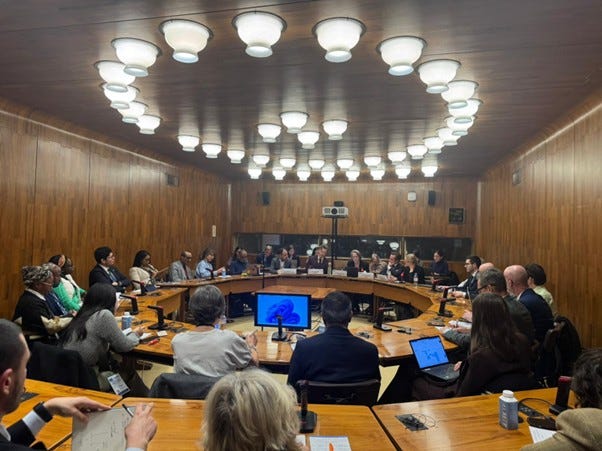
At UNESCO’s International Symposium on the Future of the Right to Education, December 9th in Paris, France, experts from across the world gathered to examine how AI is reshaping what it means to guarantee education as a universal human right.
In a panel debate moderated by Mark West (Programme Specialist, Future of Learning and Innovation Division, UNESCO), Maria Smirnova (Human rights UNHC), Lucas Chevalier (Head of International Projects, Center for Media and Information Literacy (CLEMI), France), Ahmed Tlili (IEEE Technical Community on Learning Technology, UNESCO Chair on AI and Education, Beijing Normal University) and Natalia Kucirkova (Professor, University of Stavanger, and Director, International Centre for EdTech Impact) discussed digital futures and education.
The conversation revealed four key themes that the experts agreed are key to understanding and revisiting the right to education in an age of AI.
1. Human Behaviour Is Already Shifting and Children Are the Front Line
AI is not only changing systems; it is changing us. From the ways adults adjust their writing to avoid being mistaken for ChatGPT, to the ways children interact with AI-powered toys and learning tools, behavioural shifts are already evident.
Yet research, especially in early childhood, is still catching up. AI is shaping children’s environments faster than evidence can be generated. This requires proactive action on the part of funders to support rapid cycles of evaluation for AI tools designed for K12.
At the same time, the panel noted a powerful counter-movement: calls for technology-free childhood and the “right to disconnect,” Funding and public discussion are being diverted to understand the added value of AI vis a vis no technology at all, a dichotomy that is perhaps too extreme to be helpful to understand the nuance.

2. Design needs to intentionally center student agency, otherwise AI Is Reinforcing Inequalities
AI systems risk deepening the divide between children who already enjoy stable, well-resourced learning environments and those who do not. Many AI-powered tools assume electricity, connectivity, powerful devices, and strong digital skills. These conditions are far from guaranteed in rural areas, displaced communities, or crisis-affected regions.
The right to education cannot be upheld if technological innovation is only accessible to the already privileged. As several speakers noted, AI must be designed for the margins, not just the mainstream, and grounded explicitly in human rights frameworks. Without this, AI will accelerate exclusion and educational inequalities.
3. Digitalization Is Colliding with Privatization
The rapid privatization of education has become synonymous with rapid digital transformation. Global research presented at the symposium shows that as AI tools proliferate, education is increasingly framed as a private service rather than a public and universal right.
The panel echoed a growing concern: when education is mediated through commercial technologies, its status as a human right is weakened. As articulated in the Universal Declaration of Human Rights, education must remain free, act as a social equaliser available to all and directed to the full development of the human personality. These principles, however, are difficult to uphold within profit-driven digital ecosystems.
4. Information or Media Literacy Is the New Educational Bedrock
As AI transforms how information is created, filtered, and distributed, media and information literacy becomes foundational. This includes the ability to understand how algorithms shape what we see, to question the sources of information, and even to engage in “prompt literacy” as AI becomes a core mediator of knowledge. National education systems are beginning to respond: teachers are being trained in AI literacy, students are engaged in debates about ethics and responsible use, and new curricula are emerging around critical engagement with AI-generated information.
These ideas lie at the very core of our work at the International Centre for EdTech Impact, which was created with a clear mission: to ensure that educational technologies are designed and used in ways that genuinely advance children’s fundamental right to education. If digital tools do not have evidence of positive impact, they risk diluting the very rights they aim to support. As we continue to participate in and shape these global discussions, we warmly encourage readers to reflect on these four themes and to share their perspectives as we collectively navigate the future of education in the age of AI.